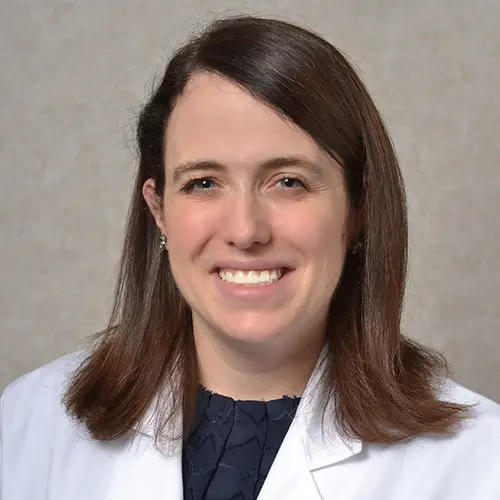
Kerry Rogers, MD
“Overcoming CLL Resistance to Targeted Agents Through Rational Combination”
Over the past decade, people with chronic lymphocytic leukemia (CLL) and small lymphocytic lymphoma (SLL) have benefited greatly from targeted therapies, particularly a class of drugs called covalent BTK inhibitors (cBTKi) such as ibrutinib, acalabrutinib, and zanubrutinib. These treatments have transformed outcomes for many patients. However, they require continuous use to keep the disease in check, and over time, CLL cells can develop resistance. When that happens, the disease returns, treatment options narrow, and each successive therapy tends to work for a shorter period of time.
Dr. Kerry Rogers and her team at The Ohio State University Comprehensive Cancer Center – Arthur G. James Cancer Hospital and Richard J. Solove Research Institute (OSUCCC – James) are conducting a Phase 2 clinical trial to test whether combining two targeted drugs, venetoclax and pirtobrutinib, can produce deeper, more lasting remissions in people whose CLL has progressed during cBTKi treatment. The study builds on earlier research showing that adding venetoclax at the point of ibrutinib resistance led to significantly longer remissions and, importantly, allowed 43% of patients to stop treatment entirely and move to a period of monitoring. Dr. Rogers and her team hypothesize that the results with venetoclax and pirtobrutinib will be even better since pirtobrutinib by itself effectively treats cBTKi-resistant CLL.
The goal of this study is to determine how many patients can reach undetectable minimal residual disease, meaning no measurable leukemia in the body, and how long that remission lasts. Participants will receive the combination therapy for 18 months, then be monitored without continuing treatment. If successful, this could establish a regimen with a defined stop date, reducing the risk of long-term side effects, slowing the development of further drug resistance, and lowering the burden and costs of treatment for patients.
The study will also collect blood samples to examine how the drug combination affects CLL cells at the molecular level. Those findings are designed to inform the development of even more effective therapies in the future, moving the field closer to more personalized approaches for people living with CLL and SLL.
About Dr. Rogers
Kerry Rogers, MD, is a physician-scientist and Associate Professor with tenure in the Division of Hematology at The Ohio State University, where she sees patients at the OSUCCC – James and leads research in the Experimental Hematology Laboratory. Her research focuses on novel therapies for CLL, with particular interests in BTK inhibitor combination regimens, Richter’s syndrome, autoimmune hemolytic anemia, and managing complications from targeted therapies. Dr. Rogers leads clinical trials studying novel regimens for the treatment of CLL and conducts related translational work in her laboratory.
A strong advocate for patient education, Dr. Rogers works closely with patient advocacy organizations to ensure that people living with CLL have access to the information they need to understand their disease and be active, informed participants in their own care.