Title of the Research Project
Discovery and Overcoming Mechanisms of Resistance to BTK Degraders
Research Project Summary:
Scientists are working to better understand how chronic lymphocytic leukemia (CLL) and small lymphocytic lymphoma (SLL) can stop responding to traditional treatments. This phenomenon is called drug resistance, and it’s an important area of cancer research. It is well known that drug resistance can develop over time when medications known as Bruton’s tyrosine kinase (BTK) inhibitors (such as ibrutinib [Imbruvica®], acalabrutinib [Calquence®], zanubrutinib [Brukinsa®], and pirtobrutinib [Jaypirca®]) are used to treat CLL / SLL.
While BTK inhibitors have revolutionized and transformed care, many patients relapse while taking these medications because of the development of drug resistance. BTK degraders are a relatively new drug class being studied for CLL / SLL and represent an encouraging new therapeutic strategy. However, it is already known that CLL / SLL can also develop resistance to them as well. This study aims to better understand how resistance develops in response to BTK degraders, lead to broader research efforts, and hopefully inform how future versions of the drug class can be improved.
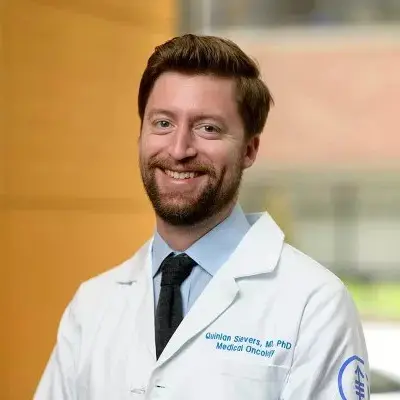
About the Award Recipient, Dr. Quinlan Sievers:
Quinlan Sievers, MD, PhD, is pursuing a career as an academic physician-scientist interested in hematology and hematologic malignancies. He obtained his MD and PhD at Harvard Medical School and conducted his thesis work in the lab of Benjamin Levine Ebert, MD, PhD, where he studied the molecular mechanism of thalidomide and its analogs. Dr. Sievers completed his internal medicine residency at University of California, San Francisco, and is now a fellow in medical oncology at Memorial Sloan Kettering Cancer Center in New York City.
How Do BTK Inhibitors and BTK Degraders Work?
Inside the body, the BTK protein helps certain white blood cells called B cells grow and survive. In CLL / SLL, these B cells become cancerous and grow uncontrollably, with BTK playing a key role. BTK inhibitors work by attaching to the BTK protein and blocking (inhibiting) it, like flipping a light bulb switch off. This deprives CLL / SLL of growth signals it needs to survive and slows down disease progression. BTK degraders go a step further. They also target the BTK protein, but instead of just blocking BTK, they force the cell to break down and destroy the BTK protein completely. Therefore, instead of turning the lightbulb switch to “off”, BTK degraders simply get rid of the light bulb altogether. This strategy may be effective even in cases where the CLL / SLL has stopped responding to regular BTK inhibitors.
Why Is This Research Important?
Drug resistance remains one of the biggest hurdles in treating CLL / SLL. Many patients respond well to BTK inhibitors at first, but eventually relapse when the cancer finds ways around the drug. BTK degraders offer a promising new option, but resistance can still develop. This research aims to uncover how and why resistance to BTK degraders happens. Understanding this will help guide scientists as they design better, longer-lasting treatments and allow healthcare providers to better plan care for patients when resistance occurs.
Who Is Eligible for This Study?
Eligibility for this study primarily includes patients with CLL / SLL who are being treated with BTK degraders as part of early-phase (phase 1) clinical trials, particularly at institutions like Memorial Sloan Kettering Cancer Center. Most participants will have relapsed or refractory CLL / SLL, meaning their cancer returned after treatment or didn’t respond well to prior therapies. Eligibility also includes the ability to provide blood or tissue samples for genetic testing both before and after treatment.
What Is the Design of the Study?
Researchers will collect and analyze samples from those being treated with a BTK degrader. Blood or bone marrow samples will be taken before treatment and again if the disease progresses. Using advanced genetic testing tools, scientists will look for mutations or other changes that occur at the cellular level that may help explain why the treatment stopped working. In the lab, they will also study the cancer cells of study participants to explore new ways future degraders might still bind to BTK, even after resistance to a BTK degrader occurs. This two-part approach will help researchers map out resistance pathways and may potentially support the development of next-generation BTK degraders.
How Will the Findings Be Used?
By identifying the genetic changes that lead to resistance, this study may help scientists and drug developers create new BTK degraders that can work even when resistance to other BTK degraders occurs. It may also lead to diagnostic tools that help healthcare providers identify drug resistance earlier and adjust treatment before the disease progresses. Ultimately, these insights aim to support more effective, personalized, and longer-lasting treatment options for people living with CLL / SLL.
Please watch the interview between CLL Society Senior Director of Scientific Affairs Robyn Brumble, RN, MSN, and Quinlan Sievers, MD, PhD.